Affichage des articles dont le libellé est Esteban Hernandez. Afficher tous les articles

mardi 9 janvier 2018

A9 - final poject akuaippa

Akuaippa

 Resume: The Akuaippa (meaning life and water in the wayuu language) is a response to the intensive draughts suffer by the people of the Guajira Colombia. We have created a device that responds to the region's characteristics to generate potable water and aliviate the humanitarian crisis. By destillating salt water from the sea, this experiment has the potential of saving many lives, and by creating a sensible, region base devise we assure it can get to as much people as possible. 

 
  Location: 
La Guajira, Colombia


La Guajira is a department of Colombia. It occupies most of the Guajira Peninsula in the northeast region of the country, on the Caribbean Sea and bordering Venezuela, at the northernmost tip of South America. The capital city of the department is Riohacha.

The economy of the department is mostly based on royalties from the coal mining at Cerrejón (producing 24.9 million tons of export coal in 2004), Natural gas exploitation and salt mines.

2. Climate:  


Its climate stands out in possessing all the characteristics of the intertropical zone with average temperatures between 22 and 40 ° C. In its ecological characteristics is variety of terrestrial ecosystems, among the most prevalent are the desert, the dry jungle and wet mountain.

In its hydrological characteristics, it counts on water tanks like aquifer wells and little lakes or “jagüeyes” that provide water to the communities. The main rivers are the Ranchería and the Cesar.
It only rains between September and December, it is the driest region in Colombia.

3. Draught in la Guajira  

 In 2014, La Guajira was declared in state of emergency because of the drought. The indigenous wayuu representatives denounced the isolation and oblivion they’ve been suffering by the Colombian government.

Referents:

We based this prototype in two referents from which we took what we foun was better and merge them into a new thing. The first one is the Desalinisateur solaire. This experiment works by heating a cloth between two sheets of plastic. Water condenses and falls into a collection recipient. The problem it has is that by having such a small area vapor quickly create a layer which blocks the sun.

The second project we took from was the Elio Domestico, This one worked by heating water in a metal container and conducting the vapor into an inferior container. We found very interesting the use of ceramic in this project but by our own experience a closed container doesn't work as good as a transparent one wich generates a green house effect. We conserved the basic system but added what we learned from the other project. 
 

Our device could be considered a merger between the two, taking the best of each one and leaving out what we consider less suited. By doing this we have created a new device one designed specially for the area of the Guajira and its specific problems.


Previous prototypes: 

  1.  


    Our first prototype used solar energy to evaporate and destillate water. We found two crucial problems which made us change it. The first was the fact that the materials did not last long. Made from recycled water bottles and cardboard, it resulted in a very easy to make prototype, however it would not withstand many uses forcing the client to constantly create new ones.

    The second problem was with its limited capacity. Because of its size it could not collect much water, not even enough for a person. Because of the type of work we thought this was a good short-term solution but would create more chaos for the long run. 

    We learned from this prototypes that it was necessary to find a valance between cost and durability. This because a low-cost with low efficiency might give quick solutions but when you have to constantly create the object over and over the cost rises. Also that size needed to find a proportion between the needs of the person or group of persons and its usability.

    2.  


    In the second prototype we experimented with the capilarity and how to help water condense in a coler surface. This can still be seen in our prototupe which uses a diferrence in temperature between the top and bottom. Also we replaced the cloth for sponges which have longer durability. The problem in this prototype was its sise and its verticality. Because of Colombias potition in the globe sun comes mostly in a vertical way, so the best way to capt solar energy is by working horizontaly.

    3. 


    The third prototype is very similar to the one we have now. This one proposed using a plastic bag for a lid but as we found out in our first prototype going cheap is not always the best solution. Plastic bags even though they are very easy to find the can easily dammage and let vapor scape loosing a whole day of work. Also the sponges where just vertical but as we found in the second prototype this is not really the best solution. Aditionally we added more ergonomical functions like the handles and proposed different ways to create them.  


Desalinating Prototype:

  How it works:


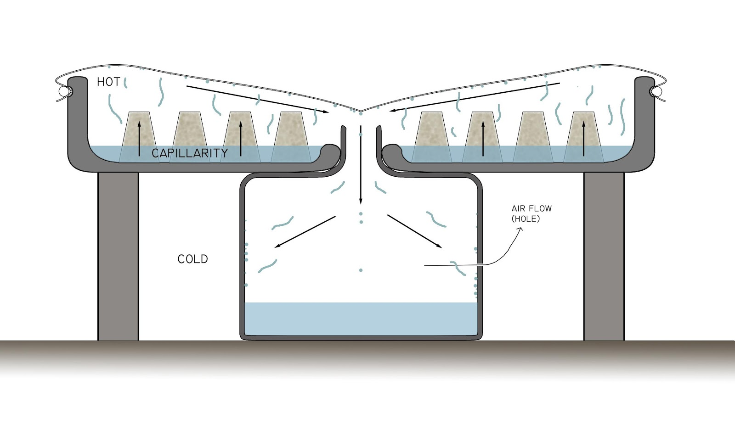
Our prototype works by the distillation of salt water from the sea and converting it into drinkablewater. The device works with solar energy and takes advantage of the physical properties of the materials that compose it. First of all the salty water is placed in a metal or ceramic  recipient, on top of this water floats a sponge which function is to absorb and facilitate the evaporation. The form of the sponge is designed to maximize the amount of solar energy according to the solar positions in that part of the ecuador.

The sponge absorbs the water by capillarity, this helps as water will lose its heat resistance, due to the waters circulation. Once vapor is being produce it will be collected in two different ways. First of all it will condensate on the upper lid, from this point it will be conducted to the center by gravity and eventually fallin the base on the bottom. The second one is when vapor starts to augment pressure it will descend through the openings and condensate in the colder ceramic surface of the jar. It's in this jar precisely where the newly drinkable water will be stored. Thanks to the effect of the upper plate which generates shadow on the bottom, this container will manage a lower temperature. Water in the tank will later be mineralized using special rocks.

Physical characteristics  


how much water?


JAR:

  • Collects up to 6’5 L
  • Weight: 1’85 kg – 8’35 (with water)


PLATE:

  • Contains 5 L
  • Weight: 10’5KG – 15’5 kg (with water)
Dimensions: 


The prototype is 51 cm width for 26cm tall, this dimensions where calculated in proportion to the weight people had to carry and the water it had to destillate.


 Tools and materials:


Materials: 
  •  Clay rocks 
  •  Mud, hay and dried canes, for the pressed soil. 
  • Sponges 
  •  Rubber tape 
  •  Plastic cover 
Tools: 
  •  Potter's wheel 
  •  Mould to make ceramic plate 
  •  Hammer and other traditional tools for ceramic

We propose a mixed program in which both the government and the locals can contribute in the creation of the dispositiv.

On the first hand the locals would create the ceramic parts, this because in this colombian region and in the culture of the Wayuu (local indigenous group) there is a very strong tradition of ceramics and are consider experts. This will not only help the population preserve their traditions but also have a feeling of pertenence. 


On the other hand the government would provide the industrial materials like the sponge and the plastic lid. This is very easy because barranquilla, one of colombias most industrial cities is not far away. It wouldn't be expensive to use the already existing facilities and materials and transport them by sea or land to the neighboring guajira. 

We propose a system in which there would be an exchange of goods, the government providing some materials and in exchange receiving the ceramics from the locals. This way it will recuperate part of the resources invested by re selling or implementing new prototypes in social programs. By doing so we assure there is  motivation in the making of this product, not only for the people who make it but investors as well. This make our project specialized for this context, understanding and utilizing its strong and weak points. 


Link to the tutorial:

Tutorial akuaipa

Thank you!

Akuaippa Water Desalinator Tutorial

Difficulty: 

Medium

Duration:

3-4 days

Cost:

5€

Introduction:

Akuaippa is a desalinating system made to solve the draught problem in the Colombian region "La Guajira". This area is characterized by high temperatures throughout the year (more than 30ºC) and only two rainy months. In 2014, La Guajira was declared in state of emergency because of the drought.
This region is a peninsula, so that the inhabitants can easily access the salt water of the sea and use it to desalinate it.

This area is populated by the Wayuu indigenous group, they constitute 48% of the population of the Department of La Guajira. The indigenous wayuu representatives denounced the isolation and oblivion they’ve been suffering by the Colombian government. These people continue to live in a traditional way and with few possessions and money.

From these conditions, we have designed a sustainable prototype to desalinate water that is easy to make and promotes the culture of the area. A device can cover the daily drinking water needs of two people. Therefore, for a family, two or three devices would be enough, depending on the size of the family or the age of its members.

Tools and Materials:

Materials:

  • Clay rocks
  • Mud, hay and dried canes, for the pressed soil.
  • Sponges
  • Rubber tape
  • Plastic cover

Tools:

  • Potter's wheel
  • Mould to make ceramic plate
  • Hammer and other traditional tools for ceramic

Stage nº1 - Functioning


Our prototype works by the destilation of salt water from the sea and converting it into drinkable water. The dispositive works with solar energy and takes advantage of the physical properties of the materials that compose it. 
First of all the salty water is placed in a metal or ceramic recipient, on top of this water floats a sponge which function is to absorb and facilitate the evaporation. The form of the sponge is designed to maximize the amount of solar energy according to the solar positions in that part of the ecuador. The sponge absorbs the water by capillarity, this helps as water will lose its heat resistance, due to the waters circulation. 

Once vapor is being produce it will be collected in two different ways. 
First of all it will condensate on the upper lid, from this point it will be conducted to the center by gravity and eventually fall in the base on the bottom. 
The second one is when vapor starts to augment pressure it will descend through the openings and condensate in the colder ceramic surface of the jar. It's in this jar precisely where the newly drinkable water will be stored. Thanks to the effect of the upper plate which generates shadow on the bottom, this container will manage a lower temperature.


Stage nº2 - Crafted ceramic

The jar and the plate are made in a traditional way, preserving the Wayuu culture of ceramics.


To make the ceramic, first crush the clay stones until you get a fine powder.

Then, water is added little by little until a homogenous mass is obtained. We knead it to remove the air bubbles and let it stand for the necessary time according to the size of the piece.


When the dough is ready, it is placed in the potter's wheel and begins to mold with the desired shape. 

 
Finally, we will obtain the jar and the plate needed for the device.


Here you will find a video where all the method is explained


Stage nº3 - Pressed Soil

The Wayuu of lower Guajira build their coconut palm homes, while those of upper Guajira due to the absence of the coconut tree they slowly build them out of mud mixed with grass and roofs of the heart of cardones (Yoto'ojolo).

This material made of mixed mud, hay and dried canes, which the Wayuu culture knows well, is the one used to make the round wall that will protect the lower part of the prototype from the sun and will keep it cold.

Stage nº 4 - Assembly

Once we have all the pieces, the assembly process begins.
First, we join the ceramic plate with the jar and make sure that the union is airtight by placing a little rubber tape.


Next, we add the sponges and we put the prefabricated plastic cover on the plate.
Finally, we put the device into the pressed soil wall so it can work properly.


Stage nº 5 - Use

The use of the device is quite simple, we just pour the salt water in the plate and close with the plastic cover. We let the device work with the sun during the day and at night we separate the plate from the jug and collect the jug to obtain the water that is inside.


Notes and references

These are some links we've used to learn about the realed to our prototype:

Clay mass elaboration: youtube video
Wayuu culture:  
wayuu people wiki 
La Guajira wiki 


dimanche 7 janvier 2018

Akuaippa - Final Instrospection

Work and learning process

During the course, we have been learning to maintain a working method and to improve it based on our mistakes. We started by investigating different physical and chemical processes that can occur with water, also different forms of use as well as different existing prototypes.
This gave us the inspiration to start experimenting and testing water distillation and desalination systems. 
Our first prototype helped us understand the water distillation process and locate the main problems.


This device's effectiveness depends in great measure on the amount of heat it can receive, in hot weather it will certainly evaporate quickly and purify water, but it can only collect a small amount because of it's size and capacity. In greater necessities we would need much more water, besides, we noticed that the system could be improved in several ways.
  
Thanks to the research of other prototypes, we learned what features significantly increase efficiency and we studied how to incorporate these improvements into our own project.
 
After having advanced a bit in the understanding of water processes, we needed to specify and define the environment in which our project is going to develop. Based on the knowledge of the area, we thought that a suitable place for our device would be the Colombian region of La Guajira. The problem of drought in the place and its climate characterized by high temperatures throughout the year, as well as its peninsular shape, made us choose it as the ideal place.

We learned that it is important to decide why and under what conditions we develop our project, as it helps us to concentrate on what is really effective for our case. At the moment we decided on our place of action, we made progress in learning about the place, its culture and the ways in which we could help and benefit with our project.

Next, we continue experimenting trying to improve the previous device, with easier materials and introducing the concept of surface increase and temperature difference. 
From this prototype we learned that the increase of surface through the fabric significantly improved the amount of evaporation and therefore the efficiency. Our main problem was still the small amount of water obtained to become useful for a person.

At this point, we try to introduce part of the culture and means that the place provides us. We designed a prototype that incorporates local craft materials as well as typical construction methods. 


With this prototype we learned that we must verify that the process on which we base our device can work in practice. We made a homemade prototype to check its effectiveness, but we discovered that it did not resemble our design enough and that we needed to improve its quality.
After this last experimentation, we felt blocked and it was difficult to find a way to improve. Finally, with the support of the teachers, we find a way to inspire ourselves and observe the best of two existing systems and incorporate the knowledge into our own.


With this we verify that the incorporation of the sponges is a great improvement in the efficiency of the prototype, although we did not obtain the results that we would have wished, we believe that it is due to a bad execution of the homemade prototype and to the lack of temperature difference.

As a conclusion, this subject has helped us to learn about the way to develop a project in a correct way and to improve our knowledge about the needs and processes that involve water. We have faced the advantages and difficulties of teamwork and we have learned not to give up when we feel blocked or think something has no solution. We think that we have managed to advance and recognize that sometimes it is necessary to take a step back.
We are ready to continue advancing and improving the device and our knowledge.


lundi 18 décembre 2017

Desalinating Prototype - Latest Experimentations

Place of Action: La Guajira, Colombia


La Guajira is a department of Colombia. It occupies most of the Guajira Peninsula in the northeast region of the country, on the Caribbean Sea and bordering Venezuela, at the northernmost tip of South America. The capital city of the department is Riohacha.

The economy of the department is mostly based on royalties from the coal mining at Cerrejón (producing 24.9 million tons of export coal in 2004), Natural gas exploitation and salt mines.

Climate:  


Its climate stands out in possessing all the characteristics of the intertropical zone with average temperatures between 22 and 40 ° C. In its ecological characteristics is variety of terrestrial ecosystems, among the most prevalent are the desert, the dry jungle and wet mountain.

In its hydrological characteristics, it counts on water tanks like aquifer wells and little lakes or “jagüeyes” that provide water to the communities. The main rivers are the Ranchería and the Cesar.
It only rains between September and December, it is the driest region in Colombia.

Drought in La Guajira:


In 2014, La Guajira was declared in state of emergency because of the drought. The indigenous wayuu representatives denounced the isolation and oblivion they’ve been suffering by the Colombian government. 

Desalinating Prototype:

 How it works:


This prototype is based on the difference of pressures between the hot zone (ceramic plate with salt water) and the cold zone (ceramic jar with a small hole to allow air flow). The difference of pressures leads the water vapor into de cold ceramic jar and there it starts condensating and falling to the bottom where the clean water is collected. 

The efficiency of the device is increased with the use of sponges that provide a greater evaporation surface and absorb water by capillarity.

This system, with the right proportions, could be able to collect up to 8 liters of water in a day.

Materials of the zone


Ceramic: Wayuu indigenous people have a strong tradition with ceramic, that's why we decided to use this material for our prototype, since they could manufacture it themselves with the means they have.

Pressed soil: They use a construction system based in pressed soil and wood, so they are able to make part of the prototype this way.

Homemade prototype:

Materials:

- Plastic/aluminium plate
- Plastic bag
- Plastic bottle (1L)
- Sponges
- Sellotape
- Silicone gun


Due to the lack of sunshine in Brussels, we use an infrarred bulb to heat the prototype and see the results.

mardi 14 novembre 2017

Workshop Chevetogne - Esteban Hernández, Margarita Aguado


Chevetogne

1st Day

For this project we parted from our initial device and improved it by adding a reflecting surface behind it. This was to potentialize the sunrays that got to our device and further improve the evaporating capacities. We hanged the experiment on a place where it could be reached by sunlight and left it there for a couple hours. After this we decided to check the temperature inside and outside the bottle in order to have a reference of work.


Ambient temperature 15°C - Time: 12:15
Laser thermometer
Temperature (°C)
Exterior surface
15
Interior surface
27
Conduction thermometer

Exterior surface
23
Interior surface
29
*The measurements taken by the laser are probably wrong because of the transparency of the measured object. This is why we can find a difference between the two methods.


From this measurements we can conclude that by creating a closed environment and adding the reflective surface the temperature inside the bottle increases by almost 10° compared with its surroundings. This is the reason behind the evaporation and later condensation of water in the walls of the device.

2nd Day


On the second day when we checked on the bottle it had recuperated some water but the cardboard inside was deteriorated. This made us think that cardboard is not the best material for constantly absorbing water for it gets damaged very quickly, and we would have to change it often. Because of this we decided to make improvements on the component and change the material for fabric. To make this we cut black tights and spread them between two wood sticks attached to the interior bottle.

3rd Day


  4th Day